
Table of Contents
ToggleThe Nintendo 64 changed gaming forever when it launched in 1996. This 64-bit console introduced millions of players to 3D gaming and created some of the most beloved titles in video game history. But what is Nintendo 64, exactly? It’s more than just a piece of hardware, it’s a cultural touchstone that shaped an entire generation of gamers. From its unique three-pronged controller to groundbreaking games like Super Mario 64 and The Legend of Zelda: Ocarina of Time, the N64 earned its place as one of the most influential consoles ever made. This article explores the history, features, iconic games, and lasting legacy of the Nintendo 64.
Key Takeaways
- The Nintendo 64 is a 64-bit home console released by Nintendo in 1996 that revolutionized 3D gaming and became a cultural icon.
- The N64 introduced the analog stick and Rumble Pak, innovations that remain standard features on modern gaming controllers.
- Iconic games like Super Mario 64, The Legend of Zelda: Ocarina of Time, and GoldenEye 007 set new standards for their genres.
- Nintendo chose cartridges over CDs for faster load times, though this limited storage capacity and increased development costs.
- The console’s four controller ports made it the ultimate local multiplayer system, defining social gaming in the late 1990s.
- Despite selling 32.93 million units worldwide, the Nintendo 64’s legacy and influence on gaming far exceed its sales numbers.
The History and Release of the Nintendo 64
Nintendo developed the Nintendo 64 as its third home console, following the NES and Super Nintendo. The company partnered with Silicon Graphics Inc. to create the system’s powerful hardware. Development began in 1993 under the codename “Project Reality.”
The Nintendo 64 launched in Japan on June 23, 1996. North America received the console on September 29, 1996, with a retail price of $199.99. Europe and Australia followed in March 1997. Nintendo sold over 500,000 units in North America during the first four months.
The console arrived during a pivotal time in gaming history. Sony’s PlayStation had already gained significant market share with its CD-based format. Nintendo chose to stick with cartridges for the Nintendo 64, a decision that proved both advantageous and limiting. Cartridges offered faster load times and greater durability, but they cost more to produce and held less data than CDs.
Nintendo positioned the N64 as a premium gaming experience. The company focused on quality over quantity, releasing fewer games but ensuring each title met high standards. This strategy created some of the most memorable gaming experiences of the era, though it also meant third-party developers often preferred the PlayStation’s cheaper development costs.
Key Features and Technical Specifications
The Nintendo 64 packed impressive technology into its compact gray shell. The console featured a 64-bit NEC VR4300 CPU running at 93.75 MHz. This processor gave the system its name and provided substantial computing power for the mid-1990s.
Graphics came from the Reality Coprocessor, which handled both graphics and audio processing. The N64 could display 16.7 million colors and supported resolutions up to 640×480 pixels. These specs allowed developers to create detailed 3D environments that felt revolutionary at the time.
The console included 4 MB of RAM, expandable to 8 MB with the Expansion Pak accessory. This upgrade became essential for certain games like Donkey Kong 64 and improved visuals in titles like The Legend of Zelda: Majora’s Mask.
The Controller Design
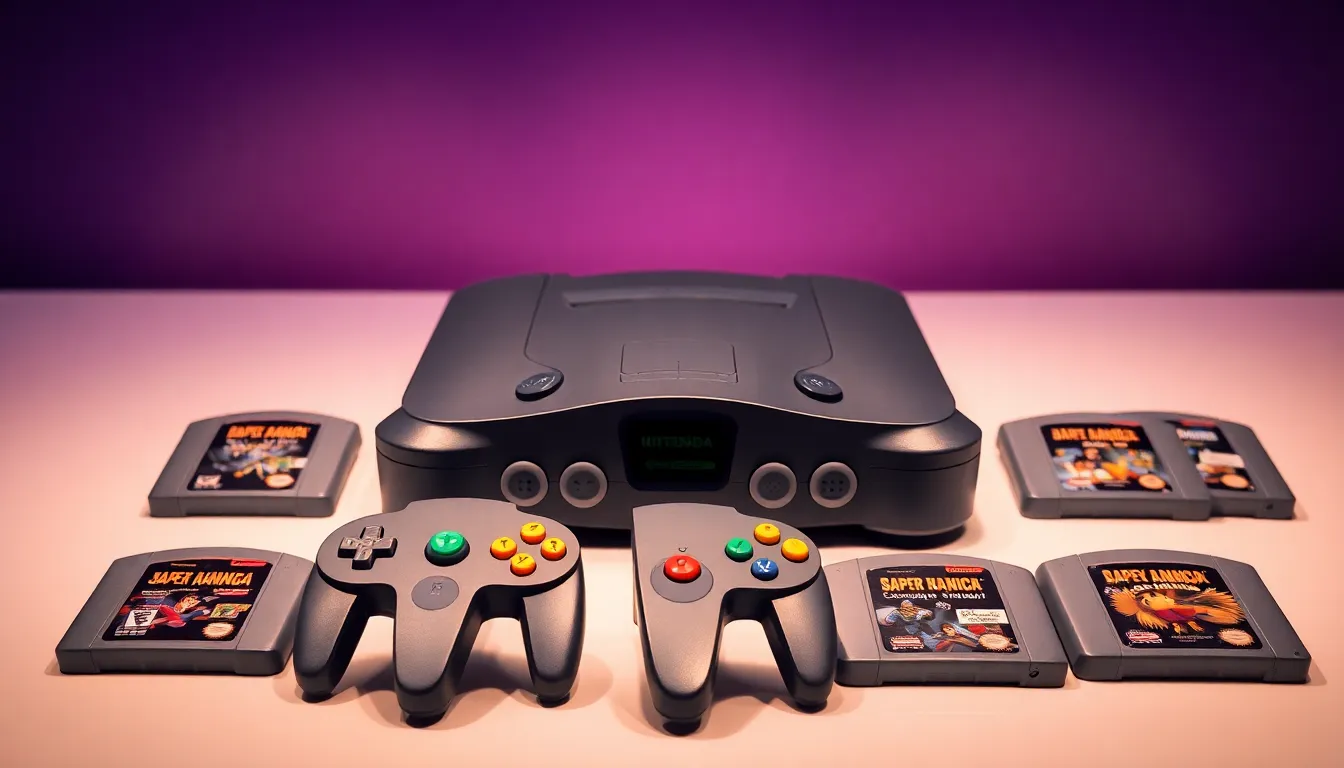
Nintendo designed a distinctive three-pronged controller for the N64. This controller introduced several innovations that influenced future gaming hardware. The analog stick offered precise 360-degree movement, making it ideal for 3D games. Players could hold the controller in three different configurations depending on the game.
The controller also featured a Z-trigger button on the back and four C-buttons for camera control. An expansion slot at the bottom accepted memory cards (Controller Paks) and the Rumble Pak, which added force feedback to compatible games.
Cartridge Format
Nintendo chose ROM cartridges over optical discs for the Nintendo 64. Cartridges ranged from 4 MB to 64 MB in capacity. This format allowed instant loading and prevented piracy more effectively than CDs. But, the limited storage space restricted game content and pushed development costs higher.
Iconic Games That Defined the Console
The Nintendo 64 library contains some of gaming’s most celebrated titles. These games showcased what the hardware could achieve and set new standards for their genres.
Super Mario 64 launched alongside the console and redefined platform gaming. Players explored Princess Peach’s castle and its surrounding worlds in full 3D. The game sold over 11 million copies and demonstrated how classic franchises could transition to three dimensions.
The Legend of Zelda: Ocarina of Time arrived in 1998 and received near-universal critical acclaim. Many publications still rank it among the greatest video games ever made. The game introduced Z-targeting, a lock-on system that became standard in action-adventure games.
GoldenEye 007 proved that first-person shooters could work on consoles. The game’s split-screen multiplayer mode became legendary among N64 owners. Four friends could compete in the same room, something that defined the Nintendo 64 social experience.
Mario Kart 64 brought the racing series into 3D and supported four-player competition. Super Smash Bros. gathered Nintendo characters for chaotic fighting game battles. Perfect Dark, Banjo-Kazooie, and Star Fox 64 further expanded the console’s appeal.
The Nintendo 64 excelled at local multiplayer gaming. Its four controller ports meant groups could play together without additional hardware. This feature made the console a centerpiece at parties and sleepovers throughout the late 1990s.
The Legacy and Cultural Impact of the N64
The Nintendo 64 sold approximately 32.93 million units worldwide before discontinuation in 2002. While this number fell short of the PlayStation’s 102 million units, the N64’s influence extended far beyond sales figures.
The console pioneered innovations that remain standard today. The analog stick became essential for 3D gaming and appears on every modern controller. Rumble feedback, popularized by the Rumble Pak, now comes built into controllers from all major manufacturers.
N64 games continue to attract players decades later. Nintendo has re-released classic titles through various services, including the Nintendo Switch Online Expansion Pack. The original cartridges and consoles have become collector’s items, with prices for complete systems rising steadily.
The Nintendo 64 shaped gaming culture in lasting ways. Phrases like “No Oddjob” (a GoldenEye 007 house rule) entered the vocabulary of a generation. Speedrunners still compete to set records in Super Mario 64 and Ocarina of Time. YouTube videos analyzing N64 games regularly attract millions of views.
Retro gaming communities celebrate the console’s unique aesthetic and gameplay experiences. The chunky cartridges, distinctive controller, and that satisfying click when inserting a game, these sensory memories connect fans to a specific moment in gaming history.
The Nintendo 64 proved that innovation matters more than raw power. Its games prioritized gameplay over graphics, creating experiences that remain enjoyable today. This philosophy influenced Nintendo’s future hardware decisions, from the Wii’s motion controls to the Switch’s hybrid design.


